



 |
 |
|
 |
On
fasting
|
 |
 |
 |
|
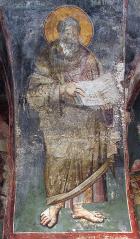
Saint Ambrose, Bishop of Milan 12/20/2013
This illustrious Father of the Orthodox Church came of a powerful family; his father was Praetorian Prefect for the Provinces of Gaul and Spain, yet a pagan, while his mother was a Christian. One day, while still a child in his cradle, Ambrose was visited by a swarm of bees that brought honey to his mouth and flew away. Even in his childhood he gave his hand forth for a blessing prophetically saying:” Kiss my hand for blessing as I am going to be a Bishop.” After his father’s death, the Emperor appointed him Governor of the Province of Liguria of which Milan was the capital. On the death of the Bishop of Milan a bitter dispute began between the Orthodox and the Arian heretics over the election of the new Bishop. As the Governor of the Province, Ambrose entered the Church to restore order to the proceedings. At that moment, a child on his mother’s breasts cried out: “Ambrose for bishop!” The assembled people accepted this as the voice of the Lord and against his will, Ambrose was unanimously elected bishop. He was baptised and in one week time he was ordained all the subordinate ranks to the episcopal rank and at the end he was consecrated bishop. As Bishop, Ambrose strengthened the Orthodox faith, subdued the heretics, decorated churches, converted many unbelievers to Christianity, composed a number of works on catechesis and served as an example of a true Christian and a true shepherd of his flock. He also composed the thanksgiving hymn: “Glory to thee, O God “. This glorious hierarch, visited by people from distant lands for his counsel and wisdom, lived his life in restraint, hard work and zeal. He hardly ever slept, he was devoted to work and prayed constantly, he fasted all days in the week except for Saturday and Sunday. That is why God allowed him to witness many miracles and granted him the gift to work miracles himself. He discovered the holy relics of the Saints Protasus, Gervase, Nazarius and Celsius (14 October). Full of meekness before the common people, he was fearless before the high-ranking. He denounced the Empress Justina as a heretic, he condemned the tyrant and murderer Maximus and he forbade the Emperor Theodosius to enter the church until he repented for his sin, while he would not even meet the violent and self-declared Emperor Eugenius. This holy man was granted with such abundant grace that he could even revive the dead; he cast out demons, healed all sicknesses and could see into the future. He fell asleep in peace at the down of Easter in the year 397.
