Orthodox calendar, hagiographies of the saints


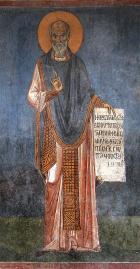
Venerable Moses the Black

Moses was an Ethiopian by birth and by profession, at first, a robber and leader of a band of robbers and, after that, a penitent and great ascetic. As the slave of a master, Moses escaped and joined the robbers. Because of his great physical strength and arrogance, the robbers chose him as their leader. Suddenly, Moses was overcome with pangs of conscience and repentance for the misdeeds, which he had committed. He left the group, entered a monastery and gave himself completely in obedience to his spiritual father and to the monastic rule. He benefited much from the teachings of Saints Macarius, Arsenius and Isidore. Later, he withdrew to solitude in a cell where he dedicated himself completely to physical labor, prayer, vigils and godly-thoughts. Tormented by the demon of fornication, Moses confessed to Isidore, his spiritual father, and from him, received counsel to fast even more and never to eat to full satisfaction. When even this did not help he, at the counsel of the elder, began to keep vigil at night and to pray standing; after that, he began the practice of bringing water to the elderly monks from a distant well all night long. After six years of terrible struggles, St. Isidore finally miraculously healed him of fornicating thoughts, fantasies and dreams brought about on him by demons. Moses was ordained a priest in old age. He founded his own monastery and had seventy-five disciples and lived in this life for seventy-five years. He foresaw his death and, one day, he told his disciples to flee for the barbarians were going to attack the monastery. When the disciples also urged him to flee with them, Moses said that he must die by violence for, at one time, he himself committed violence and, according to the words: "For all they that take the sword shall perish with the sword" (St. Matthew 26:52). He remained there with six brethren and the barbarians came and slew them. One of the brethren, hidden in the vicinity, beheld and saw seven shining wreaths as they descended upon the seven martyrs.

Venerable Sabbas of Pskov and Krypetsk

Sava was a Serb by descent. He lived a life of asceticism, at first, in the monastery of the Holy Birth-giver of God in Pskov and then was abbot of that monastery. But they praised him and he fled from the glory of men and withdrew to the shores of Lake Krypetsk where he founded a new community dedicated to St. John the Theologian. Nevertheless, even here, he was unable to conceal his fame and prominence. He was visited by Prince Yaroslav of Pskov and his wife. Sava would not allow his wife to enter the monastery but rather blessed her and prayed to God for her outside the monastery and healed her of a certain disease. This saint of God found rest in the year 1495 A.D. and his relics were and remained miracle-working.

The Beheading of Saint John the Baptist

Herod Antipas, son of the elder Herod, who was the slayer of the children of Bethlehem at the time of the birth of the Lord Jesus, was ruler of Galilee at the time when John the Baptist was preaching. This Herod was married to the daughter of Aretas, an Arabian prince. But Herod, an evil sprout of an evil root, put away his lawful wife and unlawfully took unto himself Herodias as his concubine, the wife of his brother Philip, who was still living. John the Baptist stood up against this lawlessness and strongly denounced Herod who then cast John into prison. At the time of a banquet in his court in Sebastia in Galilee Salome, the daughter of Herodias and Philip, danced before the guests. The drunken Herod was so taken by this dance that he promised Salome that he would give her whatever she asked of him, even though it be half of his kingdom. Being persuaded by her mother, Salome asked for the head of John the Baptist. Herod gave the order and John was beheaded in prison and his head brought to him on a platter. John's disciples took the body of their teacher by night and honorably buried it and Herodias pierced the tongue of John with a needle in many places and buried the head in an unclean place. What later happened to John the Baptist's head can be read on February 24. However, God's punishment quickly befell this group of evil doers. Prince Aretas, in order to cleanse his daughter's honor, attacked Herod with his army and defeated him. The defeated Herod was sentenced by the Roman Caesar, Caligula, to exile at first to Gaul and later to Spain. As exiles, Herod and Herodias lived in poverty and humiliation until the earth opened up and swallowed them. Salome died an evil death on the Sikaris (Sula) river. The death of St. John occurred before the Pascha (Passover) but its celebration on August 29 was established because, on that day, a church which had been built over his grave in Sebastia by Emperor Constantine and Empress Helena was consecrated. In this church the relics of John's disciples, Eliseus and Audius, were also placed.